

Unexpected shuttle delays are one of the fastest ways to sour a guest's experience before they even walk through the door. A corporate conference with 2,000 attendees, a wedding with guests spread across three hotels, a music festival with staggered set times — each scenario demands precise shuttle coordination. Get it wrong and you're fielding complaints before the keynote starts. Get it right and guests arrive relaxed, on time, and ready to engage. This guide walks you through every step of building an efficient shuttle schedule, from collecting the right data to measuring success after the event wraps.
Table of Contents
- What to know before you start scheduling
- Step 1: Map demand and identify shuttle hot spots
- Step 2: Design efficient routes and schedules
- Step 3: Use shuttle scheduling software for automation and tracking
- Common mistakes and troubleshooting tips
- How to measure success and improve for next time
- Shuttle planning made simple with private-transfers.com
- Frequently asked questions
Key Takeaways
| Point | Details |
|---|---|
| Demand mapping matters | Understanding where and when guests need shuttles prevents crowding and confusion. |
| Automate for efficiency | Shuttle software streamlines scheduling and drastically reduces error risk. |
| Adapt to surges | Real-time data and flexible plans keep shuttles running smoothly during demand peaks. |
| Feedback improves results | Measuring and reviewing shuttle logistics ensures smoother events next time. |
What to know before you start scheduling
Before you touch a single route or time slot, you need the right information in hand. Jumping into shuttle logistics without foundational data is the number one reason schedules fall apart on event day. Think of it like building a house — no blueprint, no structure.
Here's the core data you need to collect upfront:
- Total expected attendance broken down by session or time block
- Session start and end times for every major program segment
- Hotel locations and distances from the venue
- Parking capacity at both the venue and each hotel
- Guest origin clusters (which hotels or neighborhoods hold the most guests)
One of the biggest misconceptions in event transfer logistics is that a single shuttle schedule works for every event. It doesn't. A gala with 300 guests and one hotel is nothing like a trade show with 3,000 attendees spread across eight properties.
The most effective planning tool you can build is a demand map. The demand mapping process involves listing sessions with high attendance, identifying pickup zones, estimating shuttle usage based on hotel distance, and marking surge periods. This gives you a visual picture of where pressure will build and when.
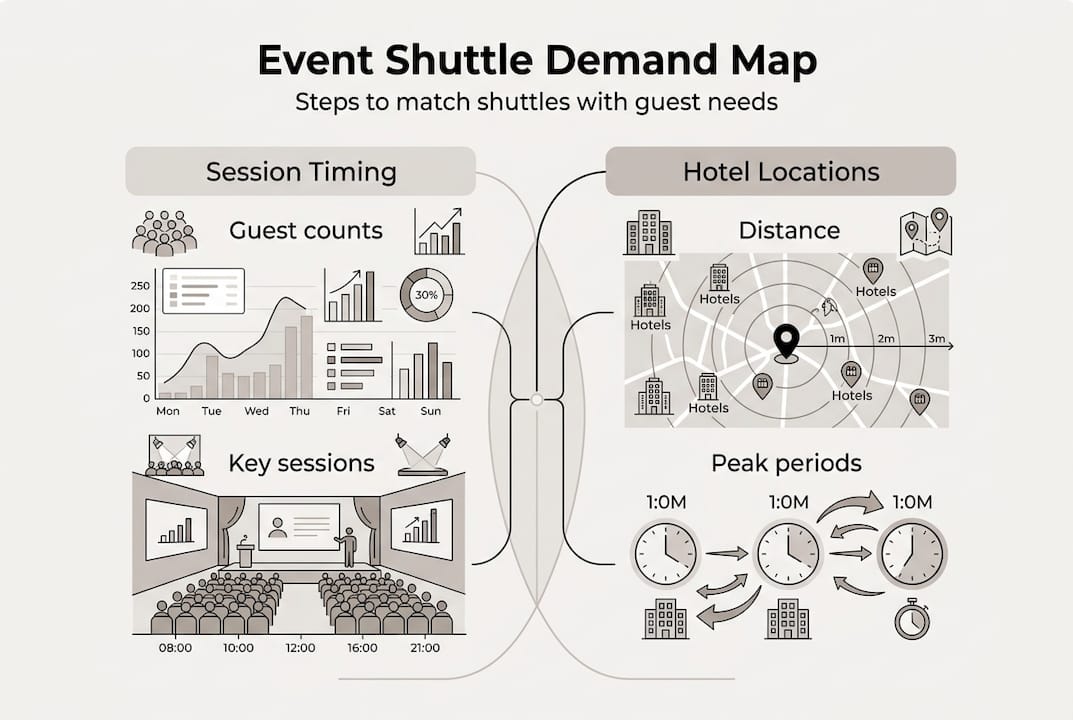
| Planning element | Why it matters |
|---|---|
| Attendance by session | Sizes your fleet per time block |
| Hotel distance | Predicts shuttle utilization rates |
| Parking capacity | Reveals dependency on shuttles |
| Session end times | Flags surge windows |
Tools that support this phase include route mapping software, event registration platforms, and improving shuttle route planning resources that help you visualize guest flow before the event begins.
Step 1: Map demand and identify shuttle hot spots
With your data collected, it's time to build the demand map and find your pressure points. This is where planning gets specific.
- List every session with expected attendance above 500. These are your high-demand anchors.
- Record exact start and end times for each session.
- Group pickup locations by hotel proximity to the venue. Hotels within walking distance need less shuttle support than those two miles out.
- Assign utilization estimates. For hotels with limited parking, plan for 70 to 75% shuttle utilization from that location.
- Flag surge windows. Most demand spikes occur 8 to 15 minutes after a session ends, not during.
That last point surprises a lot of planners. Guests don't rush out the second a session ends — they network, grab a coffee, check their phones. Then they all head for the shuttle at once. Plan for that delay.
Statistic to know: Hotels with limited on-site parking generate 70 to 75% shuttle utilization, making them your highest-priority pickup zones.
Pro Tip: Use ticket scan data or event app sign-ins to refine your attendance estimates per session. Registration numbers are often inflated by 15 to 20% due to no-shows, so real scan data gives you a more accurate fleet size.
Review best practices for event logistics to cross-check your demand map against industry benchmarks before finalizing your shuttle count.
Step 2: Design efficient routes and schedules
With your demand map clear, the next step is to design shuttle routes and schedules that keep guests moving with minimal wait.
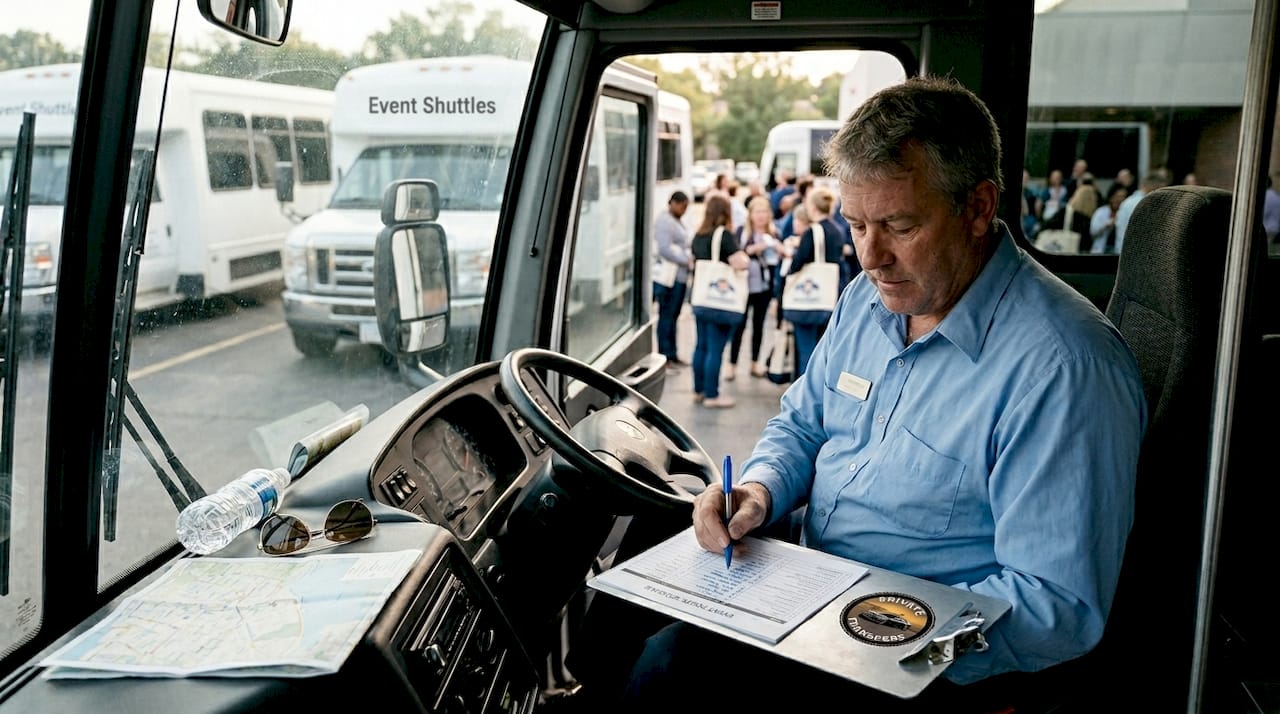
There are three main routing models to consider:
| Route model | Best for | Trade-off |
|---|---|---|
| Direct (point-to-point) | Single hotel, high volume | Requires more vehicles |
| Loop | Multiple hotels, moderate volume | Longer ride times |
| Express | Largest hotels during peak windows | Less flexible for off-peak |
For most mid-to-large events, a hybrid approach works best. Run express routes to your two or three highest-volume hotels during peak windows, and loop routes for smaller properties during off-peak periods.
Aligning your schedule with session flow is critical. Shuttles should be staged and ready 10 minutes before a session ends, not dispatched when guests are already waiting. Use these dispatch levers to manage peaks without adding vehicles:
- Headway compression: Reduce intervals to 10 to 12 minutes during peak demand windows
- Redeployment: Pull vehicles from low-demand routes and reassign them to surge zones
- Staging: Pre-position reserve shuttles near high-traffic exits before sessions end
Pro Tip: Run dedicated express shuttles to your largest hotel property during the post-keynote rush. A single express run can move 50 to 60 guests in one trip, cutting wait times by half compared to a loop route.
Think carefully about route plan considerations when deciding between models, and factor in local traffic patterns that could affect shuttle route efficiency during peak hours.
Step 3: Use shuttle scheduling software for automation and tracking
To avoid delays and human error, integrating shuttle scheduling software is the next game-changing step.
Manual planning works for small, simple events. But once you're managing multiple routes, dozens of vehicles, and thousands of guests, the margin for error grows fast. Manual planning risks errors during surges, and reactive dispatching always lags behind demand.
Here's what to prioritize when evaluating software:
- Real-time GPS tracking so dispatchers see every vehicle's location at a glance
- Automated dispatch triggers that respond to demand spikes without manual input
- Guest notification apps that push live shuttle ETAs directly to attendees
- Analytics dashboards that log ridership, wait times, and route performance
- Route optimization engines that recalculate paths based on traffic or vehicle delays
Real-time shuttle tracking and automated dispatching reduce the need for constant radio communication and allow your team to focus on guest experience rather than logistics firefighting.
| Feature | Manual planning | Software-driven planning |
|---|---|---|
| Surge response | Reactive, delayed | Predictive, automated |
| Guest communication | Manual announcements | Push notifications |
| Route adjustments | Slow, error-prone | Real-time, data-driven |
| Post-event reporting | Anecdotal | Data-backed analytics |
For planners exploring software-driven shuttle planning, the analytics feature alone pays dividends — it turns every event into a learning opportunity for the next one.
Common mistakes and troubleshooting tips
Even the best plans can run into trouble. Stay ahead by avoiding the most common shuttle scheduling mistakes.
Here are the pitfalls that catch planners off guard most often:
- Missing surge windows by scheduling shuttles based on session start times rather than end times plus a 10-minute buffer
- Ignoring parking constraints at hotels, which forces guests to rely on shuttles more than your plan anticipated
- Failing to push real-time updates to guests when a shuttle is delayed or rerouted
- No backup vehicles staged during high-risk windows like post-keynote or end-of-day rushes
- Underestimating the last shuttle problem — guests who miss the final run have no fallback option
"Predictive scheduling beats reactive troubleshooting every time."
The shift from reactive to predictive is the single biggest upgrade a planner can make. Predictive dispatching uses demand maps and historical data to position vehicles before guests need them, not after the line forms.
Review common transfer problems to understand how similar logistics challenges play out in real-world scenarios and how to build contingency plans around them.
How to measure success and improve for next time
Finishing strong means making next time even better. Here's how to measure what matters and evolve your shuttle scheduling.
Start with these key metrics:
- Average shuttle wait time per pickup zone
- Max and minimum ridership per trip to spot over and underutilized routes
- On-time departure percentage across all scheduled runs
- Guest satisfaction scores from post-event surveys
Surveys are underused in shuttle planning. A simple three-question post-event survey asking about wait time, comfort, and communication quality gives you qualitative data that numbers alone can't capture.
Pro Tip: Hold a 30-minute debrief with your shuttle partners within 48 hours of the event. Memory fades fast, and the details that felt minor on event day often reveal the biggest process gaps.
Shuttle software analytics make post-event review far more structured. You can pull ridership curves, identify which routes ran hot or cold, and build a baseline for your next event's demand map.
For a deeper look at how data shapes better decisions, explore event logistics analysis approaches that turn raw shuttle data into actionable planning improvements.
Shuttle planning made simple with private-transfers.com
Ready to turn your shuttle plan into reality? The right transportation partner removes the guesswork and gives you a reliable foundation to build on.
Private event shuttle services through private-transfers.com connect event planners with vetted, professional drivers and vehicles sized for any group. Whether you're coordinating airport arrivals for a corporate retreat or managing multi-hotel pickups for a conference, fixed transparent pricing means no last-minute surprises. You can also explore Las Vegas shuttle scheduling as a model for high-volume event transport in a city that runs on seamless guest movement. Request a quote today and give your guests the smooth, stress-free arrival they deserve.
Frequently asked questions
What is a demand map and why is it important for event shuttles?
A demand map is a visual or tabular tool that shows where, when, and how many guests will need shuttles. It's essential for directing vehicles efficiently because it lets you anticipate surge periods rather than react to them.
How do I minimize shuttle wait times during peak demand?
Compress dispatch intervals to 10 to 12 minutes, reassign vehicles from low-demand routes, and pre-stage backup shuttles near high-traffic exits. These dispatch levers cut wait times without requiring additional vehicles.
When should I use shuttle scheduling software versus manual planning?
Software is the right call when you're managing multiple routes, large guest counts, or complex session schedules. Manual planning risks surge errors that software handles automatically through predictive dispatching.
What are some key success metrics for shuttle scheduling?
Focus on average wait time per zone, ridership per trip, on-time departure rate, and guest satisfaction scores. Shuttle analytics tools make tracking these metrics straightforward and turn every event into a data-driven baseline for the next.