

TL;DR:
- Proper airport transfer planning influences attendee impressions and overall event success.
- Mid-capacity shuttle buses offer an ideal balance of reliability, capacity, and sustainability.
- Investing in seamless, professional transfers provides high return through enhanced reputation and reduced stress.
Airport transfers are rarely the first thing on a conference planner's checklist, but they might be the most consequential. A delayed pickup, a confused driver, or a fleet that can't handle group size turns a well-planned event into a frustrating experience before the first session even begins. The right transfer strategy shapes attendee mood, protects your event's reputation, and removes a massive operational headache from your plate. This guide covers everything from choosing the right vehicle type to scheduling best practices, cost tradeoffs, and sustainability considerations so you can make confident, informed decisions.
Table of Contents
- Why airport transfer logistics matter for conferences
- Types of airport transfer solutions for conferences
- Scheduling and coordination: Avoiding common pitfalls
- Cost, comfort, and sustainability: What to balance
- A planner's secret weapon: The overlooked ROI of seamless transfers
- Partner with global experts for your next conference transfer
- Frequently asked questions
Key Takeaways
| Point | Details |
|---|---|
| Impactful attendee transfers | Conference airport transfer logistics directly affect attendee satisfaction and event reputation. |
| Mid-size shuttles lead | 21-30 seat shuttle buses are the optimal choice for corporate groups in most cities. |
| Plan and coordinate early | Advance scheduling and clear attendee coordination reduce transfer risks and stress. |
| Balance cost and comfort | Smart planners weigh cost, reliability, and sustainability to meet both budget and brand goals. |
Why airport transfer logistics matter for conferences
Most planners spend months on venue selection, catering, and speaker lineups. Airport transfers often get 20 minutes of attention and a last-minute vendor call. That imbalance creates real risk. When attendees land after a long flight and can't find their ride, or wait 45 minutes in a taxi line, that frustration sticks. It colors how they feel about everything that follows.
The stakes are higher than most realize. Conference success depends on dozens of small moments, and the arrival experience is the first one. A smooth, professional transfer signals that the event is well-organized and that attendees are valued. A chaotic one signals the opposite, and that impression is hard to reverse.
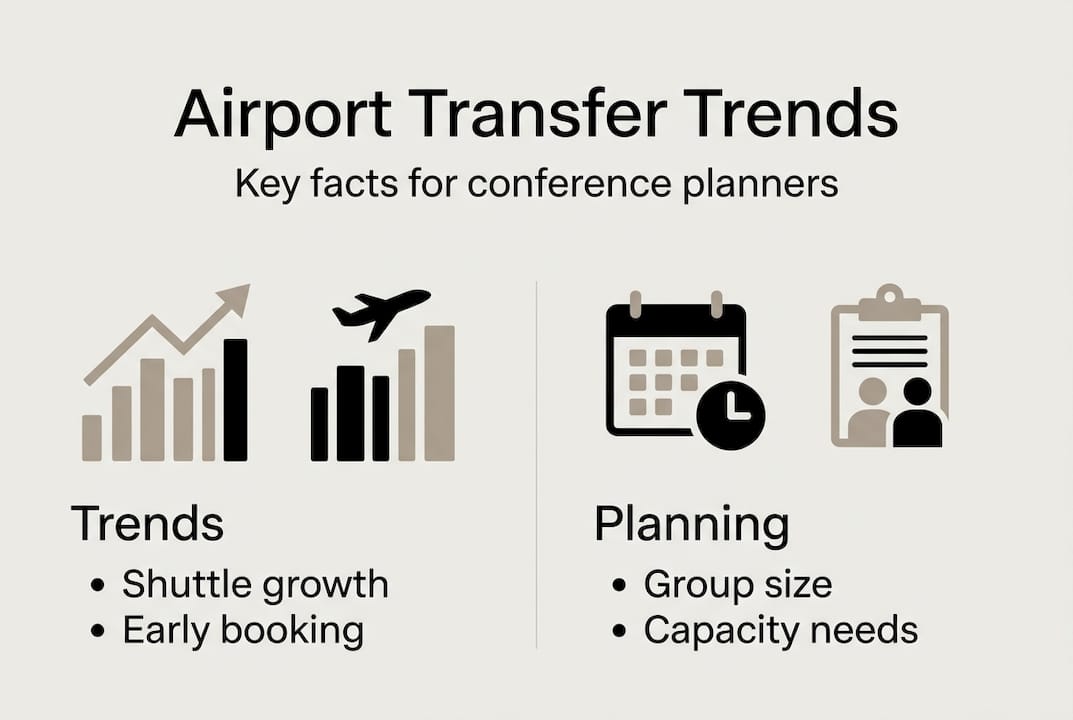
Here's what the data shows: the airport shuttle market is growing rapidly, with 21-30 seat buses now dominating corporate group movements. That's not a coincidence. It reflects what experienced planners have learned through trial and error: mid-capacity shuttles hit the sweet spot between flexibility and group management.
When surveyed, event professionals consistently rank transportation as one of their top three logistical challenges. It's not just about getting people from point A to point B. It's about timing, communication, backup plans, and making sure every attendee feels like someone thought about their journey.
Key reasons airport transfers deserve serious planning attention:
- First impressions form before the event starts, during the arrival journey
- Delayed or missed pickups generate negative social media posts and word-of-mouth
- Group transfer failures cascade into late session starts and schedule disruptions
- Attendee comfort during transit directly affects their energy and engagement at the event
"The arrival experience is the handshake of your event. Get it wrong, and you're already playing catch-up."
Understanding market trends for airport transfer helps planners anticipate demand and book the right capacity early. With the stakes set, let's break down the key models and solutions event planners can choose from.
Types of airport transfer solutions for conferences
Not every conference needs the same transfer setup. A 50-person executive summit has different needs than a 500-person industry conference. Matching the transfer type to your event profile is one of the most important decisions you'll make.
Private shuttle buses are the workhorse of conference transfers. 21-30 seat shuttles dominate corporate transfer programs because they balance capacity, cost, and scheduling efficiency. You can run multiple loops from the airport to the hotel without the chaos of coordinating dozens of individual vehicles.
Executive cars and chauffeur services are ideal for VIP guests, keynote speakers, and C-suite attendees. They offer flexibility, privacy, and a premium feel. The tradeoff is cost and scalability. You can't move 200 people with executive sedans without a significant budget.

Ride-share and taxis might seem convenient, but they introduce unpredictability. Surge pricing, driver availability, and inconsistent vehicle quality make them a poor fit for group conference logistics. They work for individual travelers who prefer independence, but they're not a reliable backbone for your transfer program.
Here's a side-by-side comparison to help you decide:
| Transfer type | Best for | Capacity | Cost level | Reliability |
|---|---|---|---|---|
| Private shuttle bus | Mid to large groups | 21-30 seats | Moderate | High |
| Executive car | VIPs, speakers | 1-4 passengers | High | Very high |
| Minivan | Small groups | 6-8 passengers | Moderate | High |
| Ride-share/taxi | Individuals | 1-4 passengers | Variable | Low to moderate |
When choosing airport shuttles for conference hotels, consider the distance between the airport and venue, the spread of arrival times, and whether you need branded vehicles for a premium brand impression. You can also explore private airport transfer options that combine shuttle and executive car services for a tiered approach.
Questions to ask before choosing your transfer type:
- What is the total headcount and how spread out are arrival times?
- Do you have VIP guests who need separate, premium service?
- Is your budget fixed per head or flexible based on service tier?
- Does your event brand require a specific vehicle aesthetic?
Pro Tip: Book a mix of shuttle buses for the general attendee group and executive cars for speakers and sponsors. This tiered approach keeps costs manageable while delivering a premium experience where it matters most.
Scheduling and coordination: Avoiding common pitfalls
Knowing your options is key, but success demands precise scheduling and communication, which brings us to best practices planners can immediately use.
Poor scheduling is the number one reason conference transfers fail. You can have the best vehicles and the most professional drivers, but if the timing is off, everything falls apart. Rising shuttle demand means capacity gets booked fast, especially during peak conference seasons in major cities.
Here's a step-by-step scheduling framework that works:
- Collect arrival data early. Send a travel survey to registered attendees at least 8 weeks before the event. Capture flight numbers, arrival times, and departure windows.
- Cluster arrivals into transfer windows. Group attendees arriving within 30-45 minute windows onto the same shuttle. This reduces the number of trips and keeps costs predictable.
- Build buffer time into every run. Add 20-30 minutes to every scheduled pickup to account for flight delays, baggage claim, and customs.
- Assign a dedicated transfer coordinator. This person monitors flight status in real time, communicates with drivers, and manages exceptions. Don't leave this to your general event staff.
- Set up a communication channel for attendees. A WhatsApp group, a dedicated event app channel, or even a simple SMS line lets attendees know where to go and when.
- Create a backup plan for late arrivals. Decide in advance whether late arrivals get a dedicated pickup or instructions for an alternative like a pre-arranged taxi account.
Review event shuttle scheduling best practices to build a scheduling template you can reuse across events.
Pro Tip: Use a shared Google Sheet or a dedicated event logistics tool to track every attendee's arrival flight in real time. Color-code by status: confirmed, delayed, or arrived. This gives your transfer coordinator a live dashboard without expensive software.
Common scheduling mistakes to avoid:
- Overbooking shuttle capacity without accounting for luggage space
- Underestimating turnaround time between airport runs
- Failing to communicate pickup point details clearly to attendees
- Ignoring departure transfers, which are just as important as arrivals
Cost, comfort, and sustainability: What to balance
Finally, planners must weigh the tradeoffs between budget, attendee experience, and sustainability for an optimal outcome.
Budget pressure is real, but cutting costs in the wrong places creates bigger problems. Attendee feedback consistently shows that comfort and reliability rank above price when it comes to transfer satisfaction. A cheaper vendor who shows up late or with vehicles in poor condition will cost you more in reputation than you saved in dollars.
Mid-capacity group shuttles offer the best balance of cost, comfort, and environmental impact at scale. Here's how different options compare:
| Option | Group size | Approx. cost per head | Comfort level | Eco rating |
|---|---|---|---|---|
| 21-30 seat shuttle | 20-30 | Low to moderate | Good | High |
| Executive sedan | 1-4 | High | Excellent | Low |
| Minivan | 5-8 | Moderate | Good | Moderate |
| Ride-share | 1-4 | Variable | Fair | Low |
Sustainability is no longer optional for many corporate clients. Companies with ESG (environmental, social, and governance) commitments require vendors who can demonstrate eco-friendly practices. Electric shuttle fleets and low-emission vehicles are increasingly available through premium transfer providers.
What to look for in a sustainable transfer partner:
- Electric or hybrid vehicle options in their fleet
- Carbon offset programs for unavoidable emissions
- Transparent reporting on fleet emissions for your event sustainability report
- Certifications or partnerships with recognized environmental standards
"Our attendees noticed immediately that we used electric shuttles. Several mentioned it in their post-event surveys as a positive detail."
For airport transfer cost strategies that don't sacrifice quality, focus on clustering arrivals efficiently, negotiating volume rates early, and choosing providers with fixed transparent pricing. Surprise fees at billing time are a common pain point with lower-tier vendors.
A planner's secret weapon: The overlooked ROI of seamless transfers
Here's something most planning guides won't tell you: the return on investing in premium transfers is often higher than the return on upgrading the venue or the catering. Why? Because transfers are invisible when they work perfectly and catastrophically visible when they don't.
Top planners treat the transfer experience as a brand touchpoint, not a commodity. When a speaker steps off a plane and finds a professional driver holding a sign with their name, a clean vehicle, and a bottle of water waiting, that moment creates loyalty. It gets mentioned in speeches. It gets shared on social media.
Cutting corners on transfers to save budget often backfires during crises. A flight delay that cascades into a missed shuttle, with no backup plan and no communication, turns into a PR problem. Premium providers with expert shuttle scheduling insights build contingency into their service. That flexibility is worth paying for.
The hidden value is in stress reduction for your team. When transfers are handled by a reliable partner, your staff can focus on the event itself instead of fielding panicked calls from stranded attendees. That operational breathing room has real value, even if it doesn't show up on a budget spreadsheet.
Partner with global experts for your next conference transfer
You've mapped the strategy. Now it's time to put the right partner behind it.

Global private transfers through private-transfers.com gives conference planners access to a worldwide network of vetted drivers, fixed transparent pricing, and flexible fleet options from executive sedans to mid-capacity shuttles. Whether you're managing arrivals in Chicago, organizing Dubai conference transfers, or coordinating across multiple cities, the platform handles the complexity so you don't have to. No last-minute negotiations, no surprise fees, no guesswork. Contact our team to get a customized quote for your next event and experience what seamless conference logistics actually feel like.
Frequently asked questions
What is the most reliable airport transfer option for conference attendees?
Mid-capacity private shuttles are the most reliable choice for group conference transfers. 21-30 seat buses dominate the corporate airport shuttle market because they balance capacity, scheduling efficiency, and cost.
How far in advance should airport transfers for conferences be booked?
Book airport shuttles at least 3-6 months in advance to secure availability and competitive rates, particularly for large events in high-demand cities during peak seasons.
Are sustainable or eco-friendly airport transfer options available for events?
Yes, many providers now offer electric or hybrid shuttle options. Mid-capacity group shuttles in particular offer strong sustainability performance for corporate events with ESG requirements.
What are common mistakes when organizing conference airport transfers?
The most common mistakes are underestimating capacity needs, skipping backup plans for flight delays, and failing to communicate pickup point details clearly to attendees before they land.
How much does a private conference airport shuttle cost?
Costs depend on destination, group size, and service level. Mid-capacity group shuttles consistently offer the best balance of cost, comfort, and sustainability for most conference budgets.